How our robots learn
Every job an Okibo robot works on makes the whole fleet better. Simulation, reinforcement learning and live data from real job sites run in one loop that ships improvements every week.
One loop, running every week.
Most robots are only as good as the day they shipped. Ours keep improving, because every change is tested in simulation, every job reports back, and every lesson reaches every robot.
- SimulateEvery change is tested in physics and fast simulation before it reaches a real wall.
- TrainReinforcement learning sharpens how each application acts, and neural networks sharpen what the robot sees.
- DeployValidated updates ship to robots working on live job sites.
- ReportEvery run reports back automatically: performance, logs and any issue.
- DiagnoseAI tools analyze field issues and trace them to the root cause.
- ImproveFixes and new cases feed back into simulation, and the loop runs again.
Two simulators. Nothing is tested on your site first.
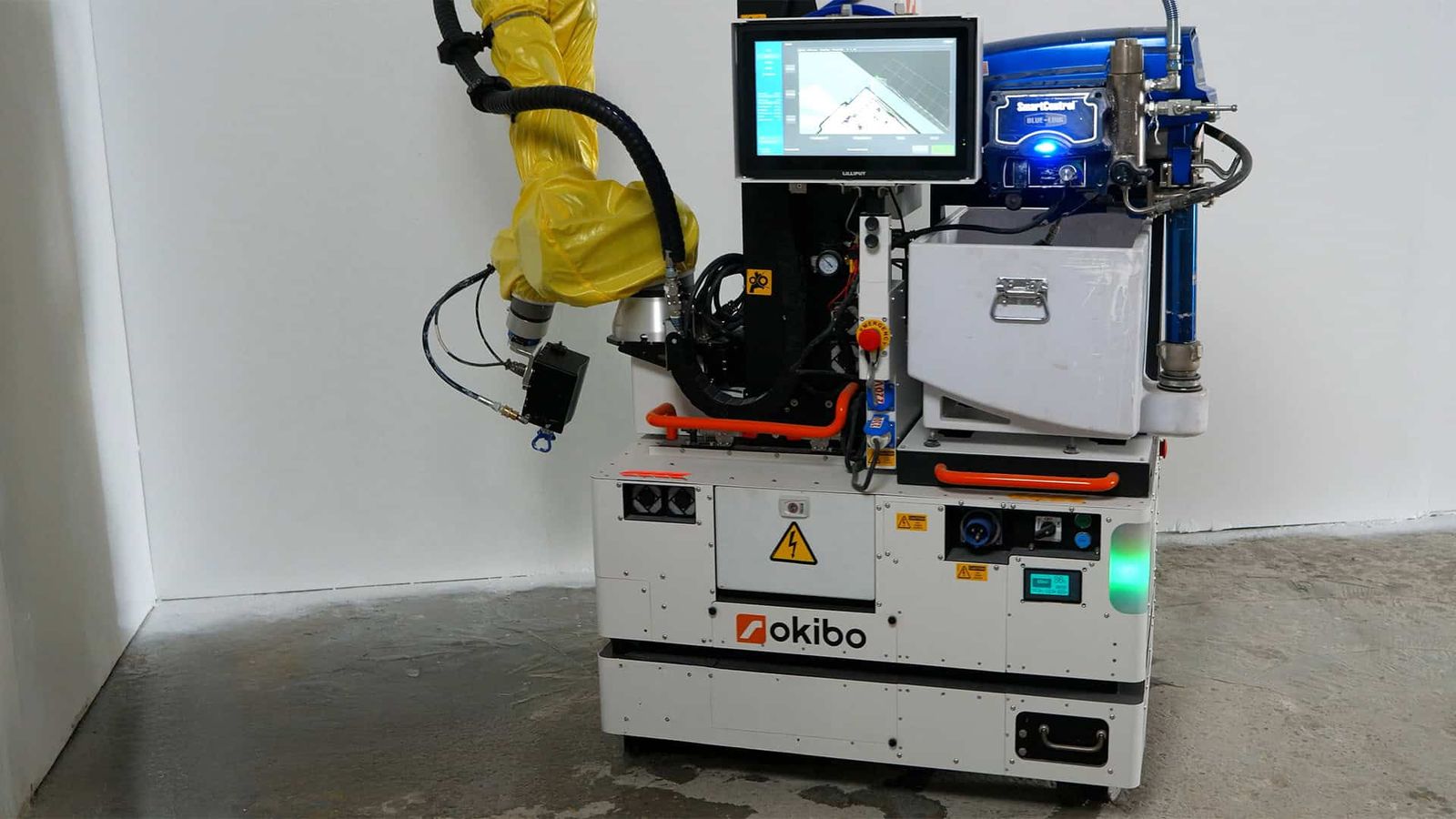
Every change to an Okibo robot runs in simulation before it reaches a real wall. We use industry-standard physics simulators such as Gazebo and NVIDIA Isaac Sim to test the full robot, its arm, tools and sensors in realistic rooms.
Alongside them we built our own mathematical simulation environment. It models what matters for each application without simulating every physical detail, so it runs far faster than a physics simulator and can put a change through a very large number of rooms, layouts and surface conditions.
- Physics simulation. Standard simulators for the full robot, arm, tools and sensors.
- Proprietary fast simulation. Our own model of each application, built for speed and scale.
Better at every application, every week.
The fast simulator is where our robots practice. With reinforcement learning, each application’s autonomous behavior is trained and refined over many simulated jobs, far more than any robot could work in the field.
Improvements are validated in simulation, then released to the fleet. Robots on site keep getting better week after week, without anyone on your crew changing a setting.
- Per-application training. Painting, sanding, finishing and coating each improve on their own.
- Validated before release. Every update proves itself in simulation first.
Trained to see a real job site.
A construction site is a hard place to see. Overspray and sanding dust fill the air, and some of the details that matter most don’t show up in 3D at all. We train neural networks for both problems.
The robot’s lidars build its 3D model, and a neural network we trained filters overspray and dust out of the point cloud, so the lidars stay reliable in exactly the conditions the robot creates. Separately, vision models segment the camera images to find what a 3D scan can’t: drywall joints are flat to a scanner, but they are exactly where Level 4 finishing has to work.
- Dust and overspray filtering. A neural network keeps the lidar point cloud clean while the robot sprays and sands.
- Camera segmentation. Vision models find 2D features such as drywall joints, which a 3D scan can’t see.
Real job sites are our best teacher.
Our robots work on live construction sites in the US and Europe. When something unexpected happens, the full log and context reach our engineers automatically and right away, with no report for anyone on site to file.
AI tools sort and analyze these reports, group related issues and trace them to the root cause, so fixes ship fast. Real deployments expose the system to conditions no lab would, and each one makes the whole fleet more robust and more stable.
- Automatic issue capture. Every runtime problem is logged with full context and sent back.
- AI-assisted analysis. Issues are grouped and traced to their root cause.
- Fleet-wide fixes. A fix found on one site improves every robot.
See every job as it happens.
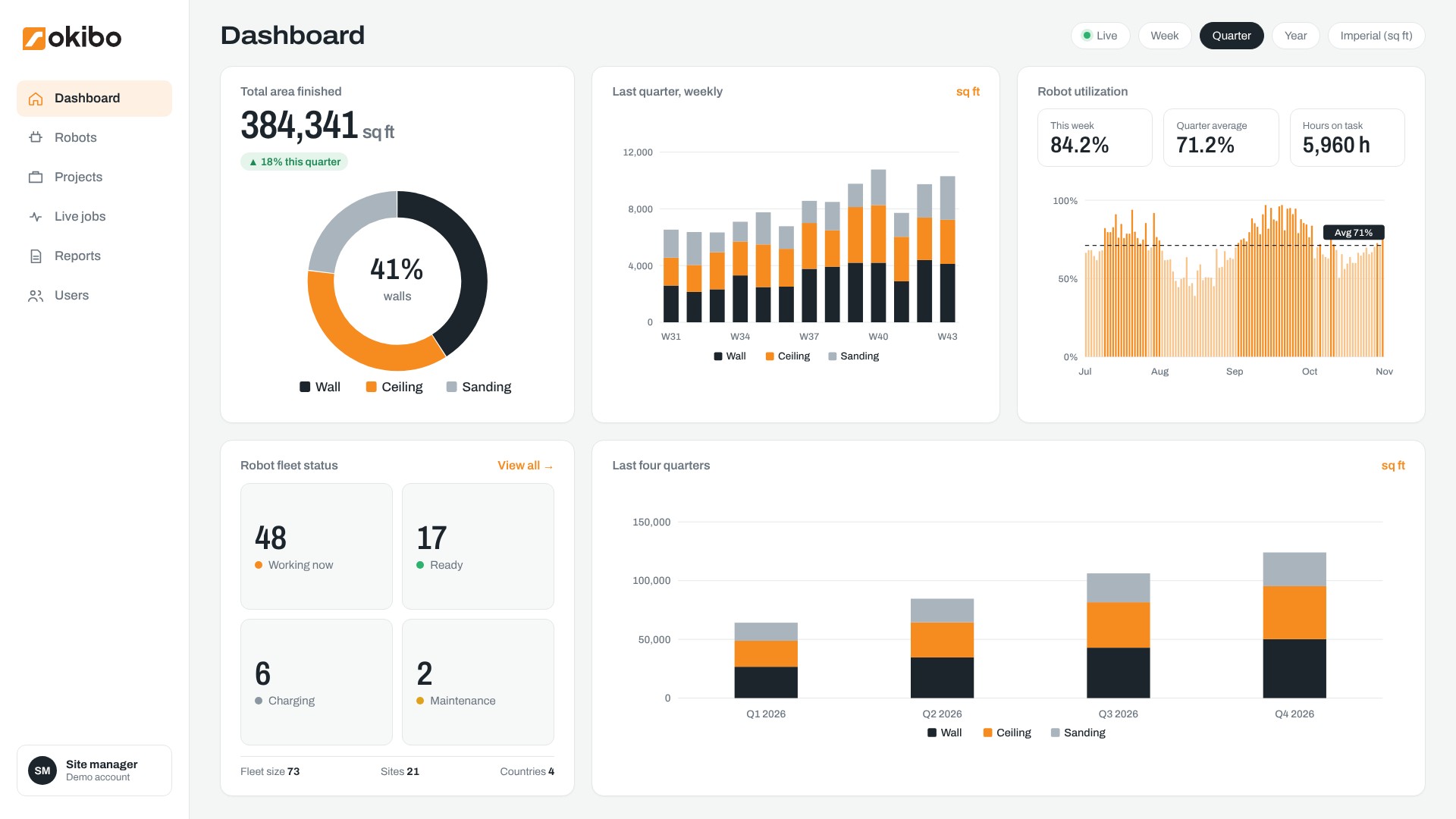
The data that improves our robots is also yours. A live dashboard shows each robot’s progress and performance on every job, for your crew, your management and your stakeholders.
- Live job tracking. Follow every robot’s progress as it works.
- Reporting. Shareable reports for your team and stakeholders.
- Performance insights. Productivity and quality, job by job and over time.
Why it matters
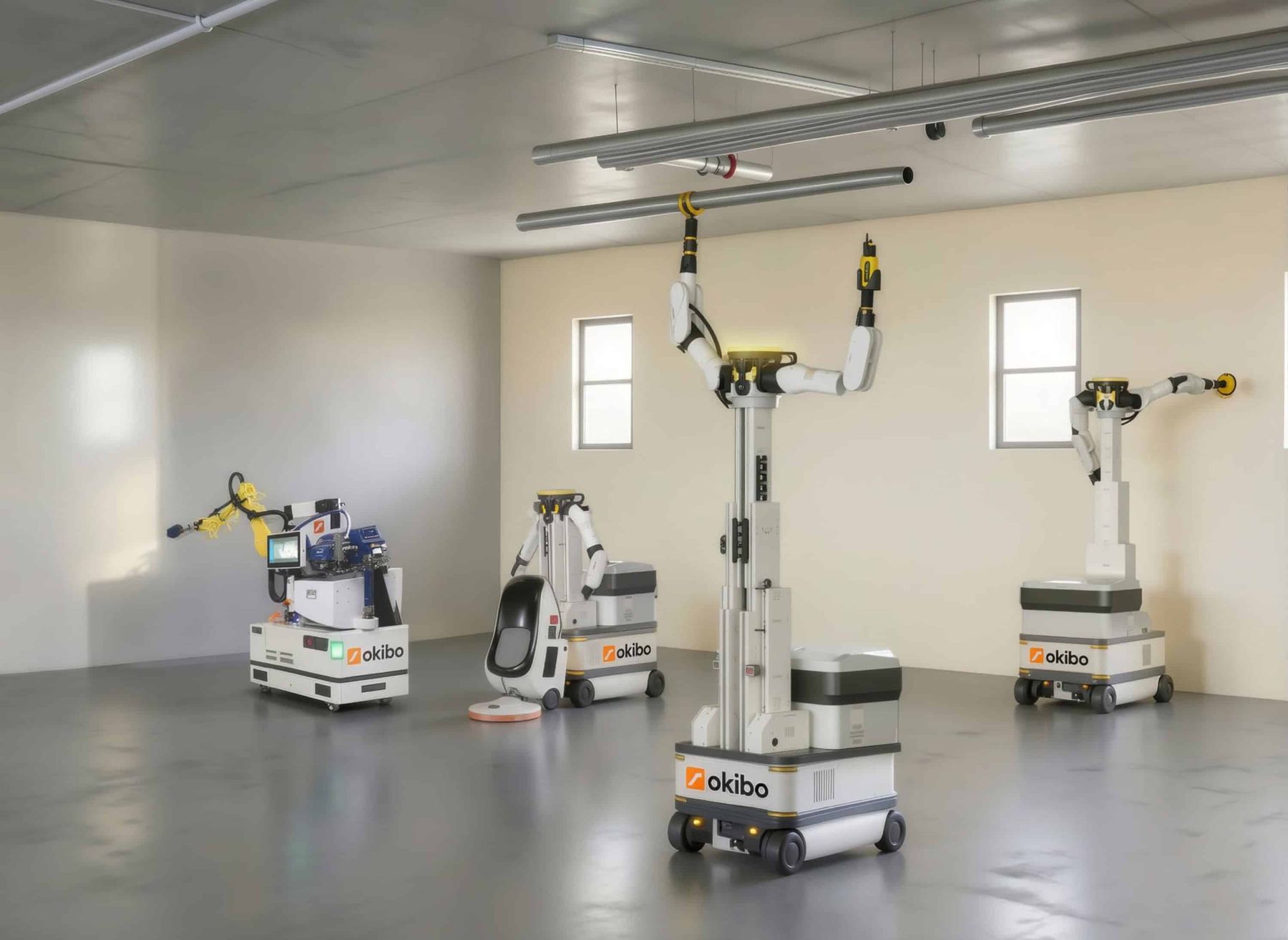
Every job teaches the fleet. Every robot gets the lesson.
The robot you bring onto your next project is better than the one that started last month, and the one after will be better still.