
Physical AI for autonomous mobile manipulation
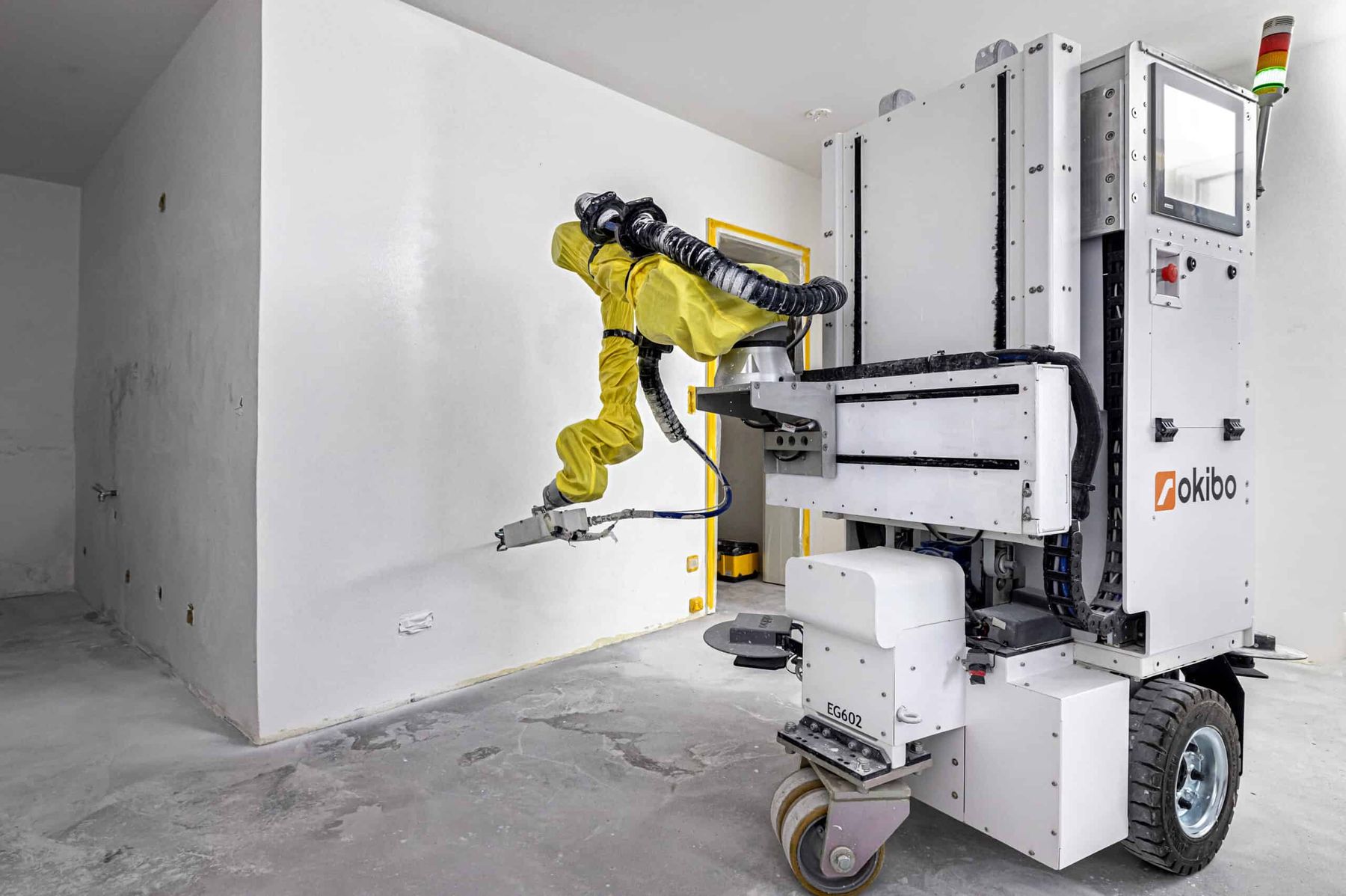
Robots shouldn’t need the environment prepared for them. Okibo’s platform lets a robot enter an indoor space it has never seen and start precise industrial work right away, without digital twins, markers, pre-scanning, offline modeling or robot programming.
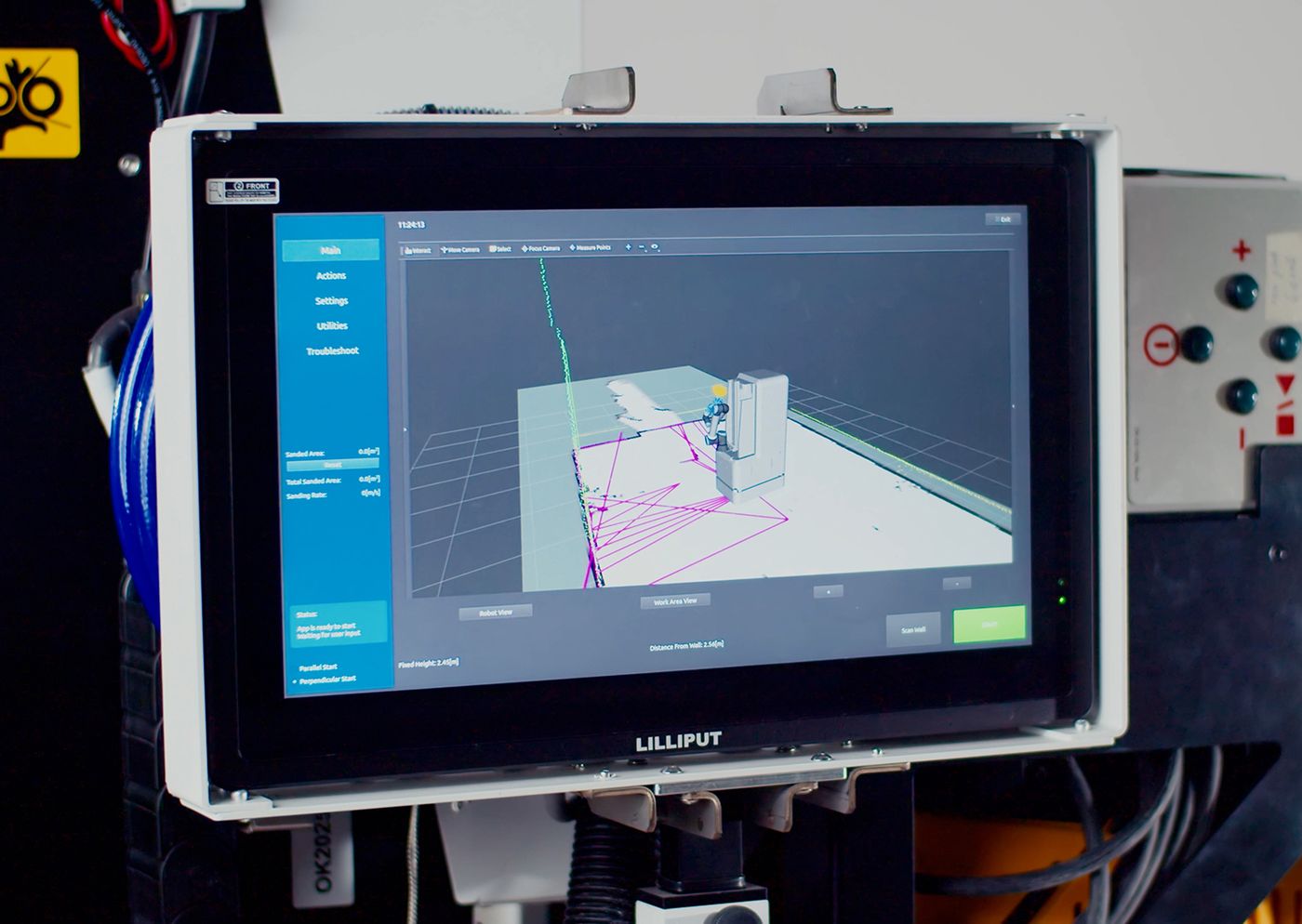
Instead of preparing the environment for the robot, the robot prepares itself for the environment.
That single difference removes the operator from the critical path. It is what makes autonomy practical on a construction site, where every room is different and nothing stays the same from one day to the next.
How other construction robots get to work
- A trained operator maps the site in advance, with a handheld scanner and the robot’s sensors
- The operator drives the robot through the space, on site or remotely
- The operator cleans up the model by hand: validates wall planes, removes noise
- The operator corrects what the robot detected, such as seams and screws
- The operator chooses where the robot works
- Work starts, with a remote operator ready to take over
The robot is only as good as the model it was given. A missed wall, a noisy scan or a wrong label carries straight into the finish. Quality depends on how skilled, careful and available the operator is, room after room.
How Okibo gets to work
- Bring the robot into the room.
- Press start.
It builds and corrects its own model as it works. There is no human-made model to get wrong.
The result doesn’t depend on who runs the robot. Anyone on the crew can operate it, and the finish is the same.
Okibo is the only industrial robot that starts working in an unprepared room with no site preparation and no specialist operator. It is possible because of AI perception and work-planning technology we have spent eight years building: the robot does the modeling, not the person.
The autonomy stack
Four capabilities run continuously while the robot works, not once before the job.
Understand
From its lidars, the robot continuously builds a live 3D model of its surroundings with Okibo’s patented AI-guided scanning, and a neural network filters out overspray and dust so the model stays accurate mid-job. Its cameras add what geometry can’t show, such as drywall joints, found by trained vision models.
Localize
A virtual-model localization engine aligns the robot to its evolving world model with 5 mm accuracy in six degrees of freedom, with no total station or external references.
Plan
It generates industrial-grade work plans automatically: which surfaces, in what order, with which tool, at what poses, and the trajectories to get there.
Execute
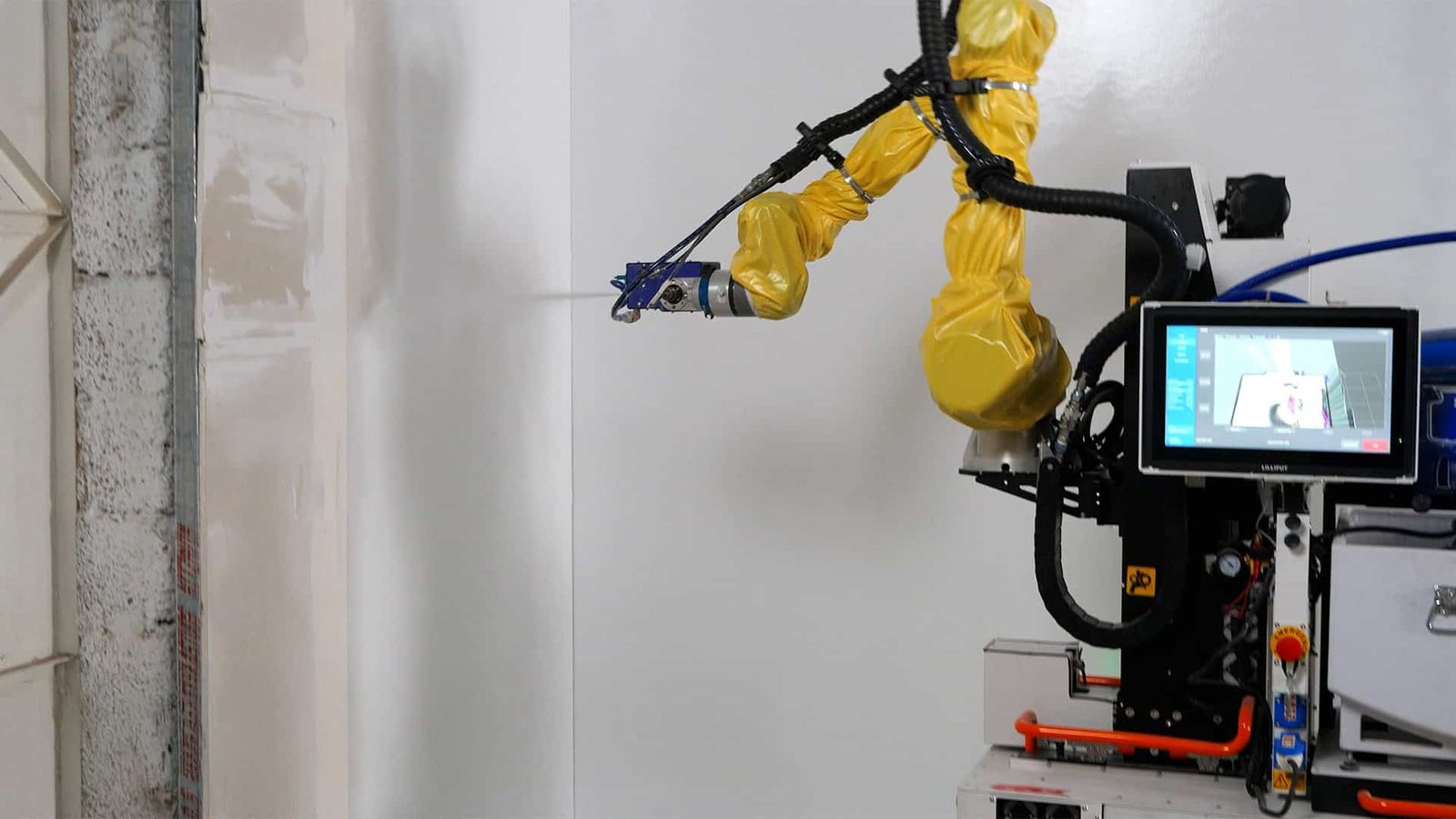
Manipulator motion, mobile-base motion and collision avoidance are planned together and adapted in real time as people, materials and the building change.
Smarter every week.
Behind every robot on site runs a loop of simulation, reinforcement learning and live field data that ships improvements to the whole fleet, week after week.
- Two simulators. Standard physics simulation plus our own fast mathematical simulator.
- Reinforcement learning. Each application keeps improving in simulation.
- Trained perception. Neural networks see through dust and overspray, and find drywall joints in camera images.
- Field data, analyzed by AI. Every issue on site comes back to us and gets fixed for the whole fleet.
- Performance dashboard. Live job tracking, reporting and performance insights.
Eight years of in-house engineering
Okibo has built its hardware, perception, planning and control in-house since 2018, and has proven them on more than three million square feet of real work.
Live 3D modeling
Patented AI-guided 3D scanning and real-time modeling. The robot builds and updates its own model of the room, so no BIM, CAD or pre-scan is needed.
Model-based localization
Aligns the robot to the model it is building with 5 mm six-degree-of-freedom accuracy, with no total station, markers or external sensors.
Automatic work planning
Turns the live model into an industrial work plan: surfaces, sequence, tool poses and trajectories, generated on the robot.
Whole-body motion planning
Plans arm and mobile-base motion together with collision avoidance, and adapts in real time as the site changes.
Multi-tool platform
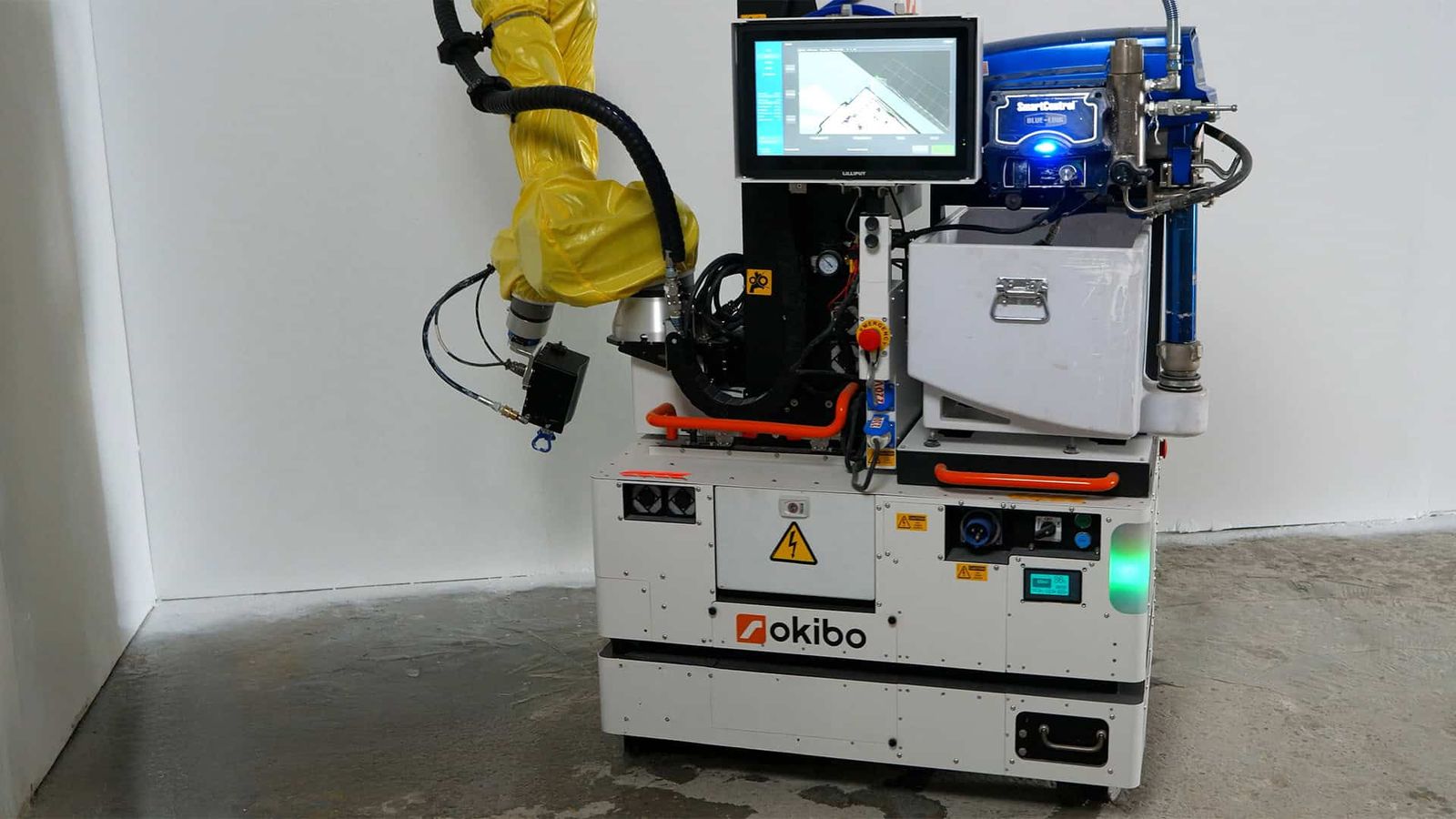
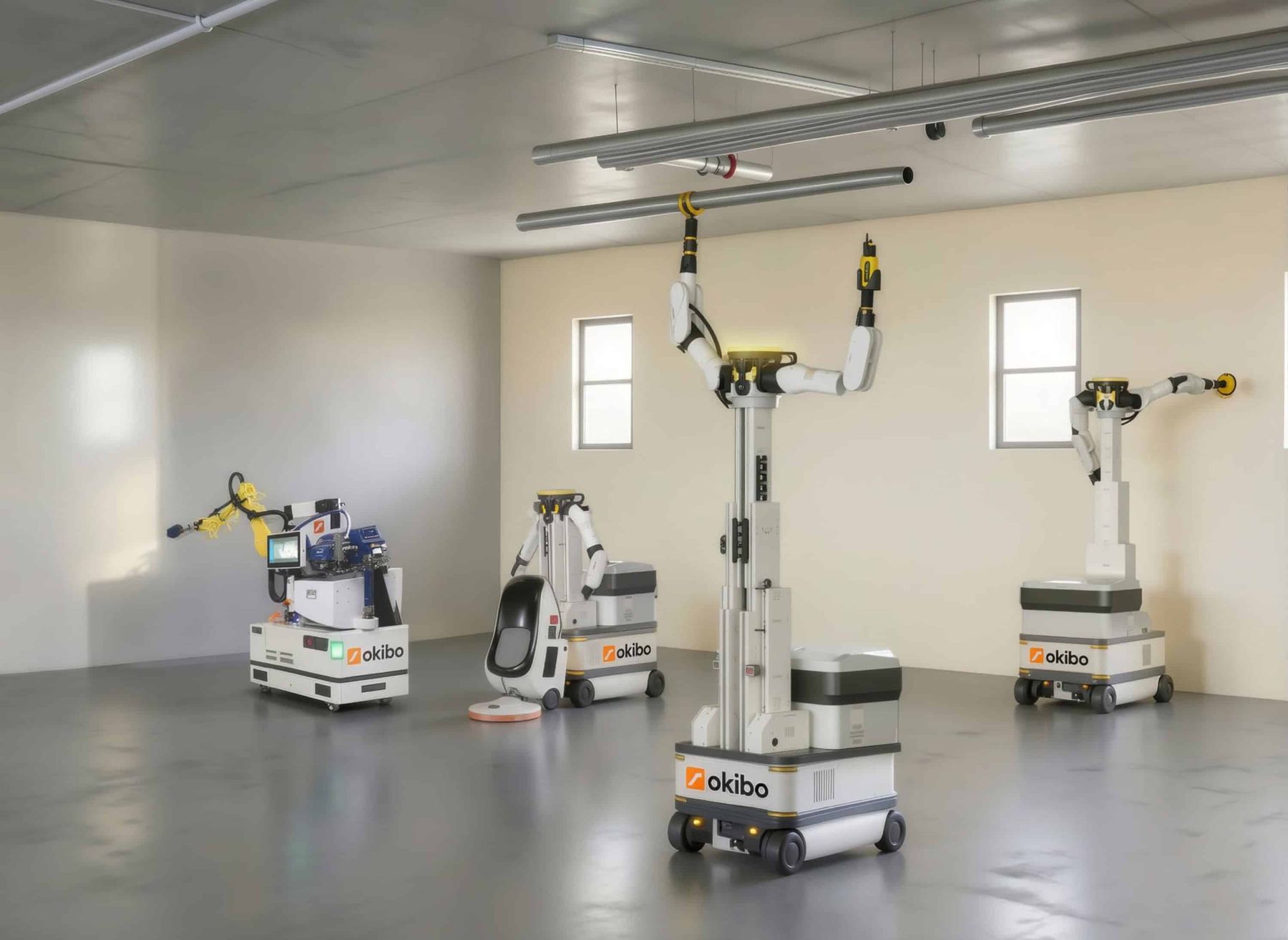
Quick-change toolheads for spraying, rolling, sanding, mud boxes and high-speed coating on the same robot.
Job-site hardware
Battery-powered, cable-free robots that fit through a standard door (EG7, CE certified) or reach 24 ft (EG7+), proven on live projects.
Why start with construction?
The application changes. The autonomy platform does not.
Construction is one of the hardest environments for robotics: every building is different, the site changes continuously and nothing is pre-engineered for automation. Solving autonomy here means solving nearly every hard problem in mobile manipulation. Any robot that must understand an unknown indoor space, plan its own work and interact with it precisely can run on the same core technology.